

What is an Integrated Packaging System?
A complete guide to modern food packaging automation
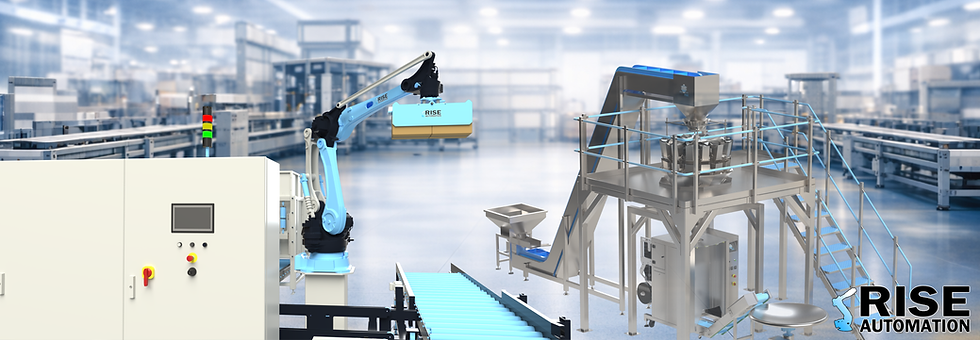
Walk into any modern food factory today and you’ll notice something very different from the production lines of the past. Instead of separate machines with lots of manual intervention moving product between them, everything flows together in one continuous process. Product enters at one end and leaves the other, weighed, packed, inspected and palletised, often without being touched by hand.
This is what’s known as an integrated packaging system.
Rather than purchasing individual machines and trying to connect them afterwards, an integrated system is designed from the outset as one complete solution. Feeding, weighing, bagging, conveying, inspection and robotics are all engineered to work together under a shared control platform. The result is higher throughput, better reliability and far less complexity for operators and maintenance teams.
At Rise Automation and Risepak, this approach is how we design and build every packaging line. Instead of “machines”, we deliver turnkey food packaging automation systems that function as one.
Custom stainless steel access platform supporting a multihead weigher within an integrated packaging Elevated weigher platform designed for safe access, structural rigidity and seamless integration int Integrated weigher platform for automated food packaging.
From standalone machines to complete systems
Traditionally, many manufacturers built lines by buying equipment from several suppliers. A weigher from one company, a bagger from another, conveyors from somewhere else and controls added later. While this works on paper, in reality it often creates added manual intervention, mismatched speeds, awkward interfaces and frustration when something stops.
An integrated packaging line removes those problems. Every element is selected, sized and programmed around the same target throughput and product characteristics. The machines communicate with each other, share data and adjust automatically to keep production running smoothly.
Instead of managing five or six suppliers, you deal with one team responsible for the entire system. That clarity alone can make a huge difference during installation, commissioning and long-term support.
Integrated product feeding
Every efficient packaging line begins with consistent feeding. If product arrives unevenly or in bursts, everything downstream struggles to maintain accuracy, that’s why integrated systems usually start with purpose-built infeed equipment such as vibratory feeders, elevators, incline conveyors or buffer hoppers. These machines transfer the product carefully and present it evenly to the weighing stage. Whether handling snacks, powders, fresh produce, pet food or bakery items, stable product flow is critical.
When feeding is engineered as part of the whole system rather than added later, it prevents bottlenecks and allows the rest of the line to operate at its true capacity.
Accurate weighing and dosing
Once the product is flowing correctly, the next step is precise portioning. This is where multihead weighers, linear weighers and auger fillers come into play. Multihead weighers are ideal for high-speed applications such as snacks and confectionery, combining multiple buckets to achieve fast and accurate target weights. Linear weighers provide a simpler solution for certain fresh or delicate products, while auger fillers handle powders like coffee, flour or protein with excellent control.
In a properly integrated packaging system, the weigher doesn’t run independently. It constantly communicates with the bagging or pouch machine, adjusting timing and discharge to match the pack rate. That coordination improves accuracy, reduces giveaway and keeps speeds consistent, for many food producers, this stage alone can deliver significant savings by minimising product waste.
High-speed multihead weigher delivering accurate portion control for automated packaging lines. Stainless steel auger filler for powder filling in automated packaging line Linear weigher providing accurate and consistent product dosing for automated packaging lines.
Bag and pouch filling machines
After weighing, product moves to the packaging stage. Depending on the application, this might be a VFFS (Vertical Form Fill Seal) bagging machine, a premade pouch machine, a sachet filler or a tray sealing system. VFFS machines are used for bags requiring forming, filling and sealing such as pillow or gusseted bags from roll stock film. Pouch machines handle stand-up or resealable formats that are increasingly popular with consumers. Each option has its place and selecting the right one depends on the product, branding and required speeds.
When these machines are integrated into the line rather than installed in isolation, they receive consistent product supply and send real-time signals back to the weigher and conveyors. If speeds change or the machine pauses, the rest of the system responds automatically. That synchronisation prevents product build-up, reduces stoppages and protects the integrity of the pack.
Conveying, inspection and handling
Conveyors might not be the most glamorous part of a packaging line but they are essential. Well designed conveying systems create smooth transitions between stages and protect both product and packaging. Integrated lines typically include stainless steel food-grade conveyors, checkweighers, metal detectors, coding systems and labellers. These ensure every pack meets safety and quality requirements before it leaves the line. Because everything shares the same control architecture, rejected packs can be removed automatically without disrupting production.
Attention to these details is what separates a basic setup from a professional, high-performance automated packaging line.
Robotics and end-of-line automation
The final stage of many systems is end-of-line handling. This is where industrial robots and palletisers can transform efficiency. Robots are increasingly used to pick, place, case pack and palletise finished products. They offer repeatability, speed and flexibility that manual labour simply can’t match. Changeovers are quicker, stacking patterns are consistent and workplace safety improves. By integrating robotics into the packaging system, manufacturers can create a complete flow from raw product to finished pallet with minimal manual intervention. It also future proofs the line, allowing capacity to increase without adding headcount.
For many growing food businesses, robotic palletising is the step that unlocks true scalability.
Why integration makes such a difference
When all these elements are engineered as one system, the benefits become obvious very quickly. Throughput increases because machines aren’t waiting on each other. Downtime decreases because controls are unified and easier to diagnose. Operators only need to learn one interface rather than several different ones.
Maintenance is simpler too. Spare parts, software and support come from a single source. There’s no finger pointing between suppliers or wasted time trying to identify where a fault sits. Perhaps most importantly, an integrated approach gives manufacturers confidence, the line is designed around their product and their targets, not pieced together from whatever equipment happens to be available.
Who benefits most from integrated packaging systems?
Integrated packaging systems are ideal for food and beverage, Logistics, Healthcare and Manufacturing sectors looking to increase output, improve consistency or modernise ageing equipment. They’re particularly valuable for growing SMEs and contract packers who need reliable performance without building large engineering teams internally.
Whether producing snacks, bakery items, powders, coffee, pet food or fresh produce, the same principle applies: when everything works together, production becomes easier to manage and far more efficient.
A smarter way to build packaging lines
Today, food packaging automation isn’t just about buying good machines. It’s about designing a system where every part supports the next. By combining weighers, pouch machines, VFFS baggers, conveyors, inspection equipment and robots into one cohesive solution, manufacturers create packaging lines and production lines that are faster, cleaner and more dependable. Instead of constant adjustments and firefighting, the line simply runs.
That’s the real value of an integrated packaging system and as more UK manufacturers look to increase capacity while controlling costs, turnkey solutions are quickly becoming the standard rather than the exception.


Comments